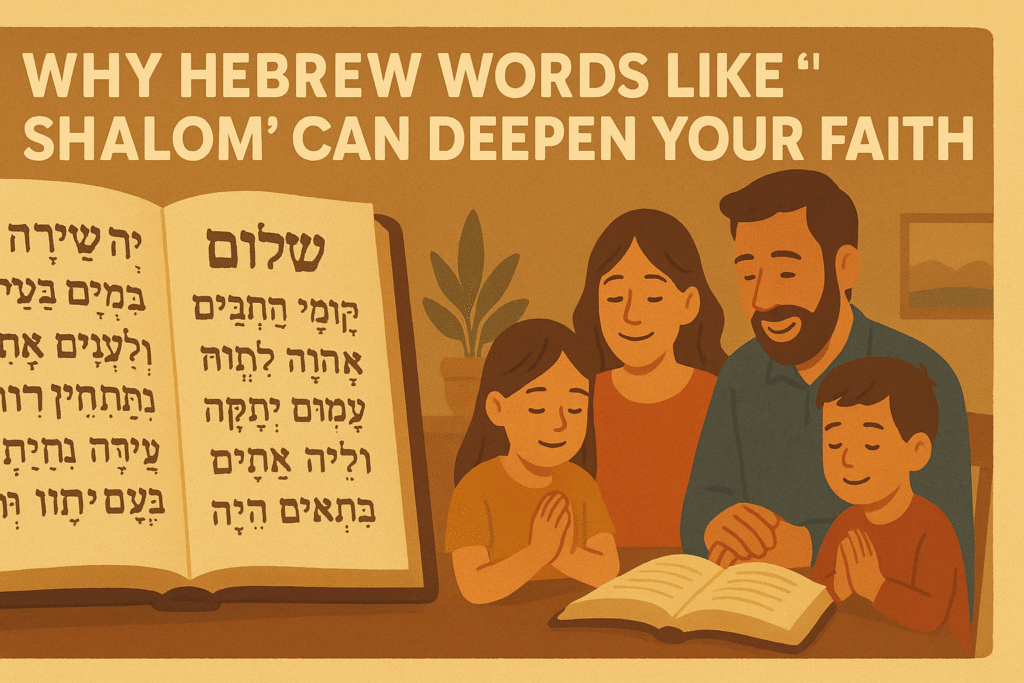
Why Hebrew Words Like “Shalom” Can Deepen Your Faith
Rediscovering the Depth of God’s Word
Most Christian parents long to pass down a vibrant, authentic faith to their children. Yet, sometimes Bible reading can feel routine—familiar words, well-worn phrases, and lessons we’ve heard countless times. What if the key to deepening your spiritual life lies in understanding the Bible as it was originally written?
The Hebrew language, rich with meaning and spiritual depth, often conveys concepts that English translations struggle to fully capture. Words like “Shalom” don’t just mean “peace” but encompass a holistic vision of well-being, harmony, and restoration.
This article will explore how understanding key Hebrew words can deepen your relationship with God, enrich your family’s faith journey, and breathe new life into Scripture.
Why Hebrew Matters to Your Faith
1. The Bible’s First Language
- The Old Testament (Tanakh) was originally written almost entirely in Hebrew.
- Hebrew isn’t just a language—it’s a worldview. Its words are packed with layered meanings, emotions, and spiritual truths.
2. English Often Flattens the Meaning
- English translations do their best, but some richness gets lost.
- For example, “Shalom” is usually translated as “peace,” but it means much more.
3. A Deeper Connection to God’s Heart
- Understanding biblical Hebrew helps Christians grasp the fullness of God’s promises, commands, and blessings.
The Power of Shalom: More Than Just “Peace”
What Does Shalom Really Mean?
- Shalom (שָׁלוֹם) isn’t merely the absence of conflict. It means wholeness, completeness, harmony, and flourishing.
- It’s God’s vision for how things ought to be—internally, relationally, and communally.
Biblical Example:
- Numbers 6:24–26 (NIV) — “The Lord bless you and keep you; the Lord make his face shine on you and be gracious to you; the Lord turn his face toward you and give you peace (shalom).”
This blessing is not just about calm—it’s a prayer for total well-being in every part of life.
Application for Families:
- Teaching your children about shalom reframes family life—not just avoiding conflict, but pursuing wholeness, forgiveness, and love.
Other Hebrew Words That Deepen Your Faith
1. Chesed (חֶסֶד) — God’s Unfailing Love
- Often translated as “lovingkindness” or “mercy”, but it means covenant loyalty, steadfast love, and undeserved kindness.
- Describes God’s faithful, relentless love toward His people.
Lamentations 3:22–23 (NIV) — “Because of the Lord’s great love (chesed) we are not consumed…”
Family Application: Teach your children that God’s love isn’t based on performance but on His unchanging character.
2. Ruach (רוּחַ) — Spirit, Breath, Wind
- Used for the Holy Spirit, God’s breath, and the wind.
- Symbolizes life, movement, power, and the unseen presence of God.
Genesis 1:2 (NIV) — “…and the Spirit (ruach) of God was hovering over the waters.”
John 3:8 (NIV) echoes this: “The wind blows wherever it pleases…”
Family Application: Help your children understand that the Holy Spirit is God’s living presence in their lives—comforting, guiding, and empowering.
3. Amen (אָמֵן) — Truly, Firm, Faithful
- More than just “so be it.” It expresses certainty, faith, and reliability.
- When you say “Amen,” you’re declaring, “This is true, I believe it, it stands firm.”
2 Corinthians 1:20 (NIV) — “For no matter how many promises God has made, they are ‘Yes’ in Christ. And so through him the ‘Amen’ is spoken by us…”
Family Application: Use “Amen” as a declaration of trust in God’s promises, not just as a routine word at the end of prayers.
How Learning These Words Transforms Faith
1. Brings the Bible to Life
- Scriptures feel less distant and more intimate when you grasp the depth of the original words.
2. Deepens Family Devotions
- Introduce one Hebrew word per week during family devotionals.
- Explore how it shapes your understanding of God and your family life.
3. Strengthens Spiritual Identity
- Understanding God’s chesed (unfailing love) and pursuing shalom (wholeness) builds a resilient, grace-filled faith in children.
Practical Ways to Incorporate Hebrew Concepts
- Bless your children daily with the Numbers 6:24–26 shalom blessing.
- Pray using Hebrew names of God (e.g., Yahweh Shalom — The Lord is Peace).
- Display Hebrew word art in your home as visual reminders of God’s character.
- Read devotionals or Bible studies that explore the Hebrew roots of Scripture.
Conclusion: The Beauty of Going Deeper
When we engage the Bible in its original language—even learning just a few key Hebrew words—we unlock layers of beauty, depth, and intimacy with God we might otherwise miss.
God’s Word isn’t just information—it’s transformation. Words like shalom, chesed, and ruach aren’t theological trivia; they’re invitations into a richer, fuller walk with Christ for you and your family.
✅ Free Resource: Growing in Grace
Want to deepen your walk with God and cultivate spiritual growth in your family? Download our free eBook, “Growing in Grace,” for practical tools to grow in faith and grace every day.